Your shopping cart is empty.
There was an error retrieving your cart. Please try again later.
Posted in Staffing & Personnel, Productivity,
Most buying decisions are overly focused on purchase price and under focused on lifetime cost. Our sales and service teams understand that the real cost of clean shows up in the years after a machine is purchased—in energy use, uptime, labor deployment, and compliance.
From the Floor is a series drawing on the experiences of Tennant’s sales and service specialists. The insights in this article were developed from conversations that happen on-site, after the sale, and over years of working in the same facilities.
This edition focuses on total cost of ownership—specifically, the questions facility managers often don’t ask when evaluating cleaning equipment, and what Tennant’s field teams have learned from the customers who wish they had:
Most cleaning equipment purchasing decisions are driven by upfront price. What’s less often calculated is what that equipment costs to run—and what it could be saving—over the years that follow.
Two technologies are worth understanding before the next purchasing decision:
Lithium ion battery systems extend run time and battery life cycle compared to traditional lead-acid alternatives. For operations running extended shifts or multiple sessions per day, the difference in uptime and battery replacement costs compounds meaningfully over a machine’s lifespan.
Robotic cleaning machines represents a longer-term shift in how staffing and equipment costs interact—explored further in the next question.
The evaluation conversation is changing. Buyers who are only comparing purchase prices are increasingly finding themselves managing costs they didn’t budget for—in energy, maintenance, and the operational gaps that present when equipment underperforms.
Labor is where the total cost of ownership calculation is most often overlooked—and it goes beyond headcount. When cleaning staff are tied to routine, repetitive tasks across large floor areas, the question isn’t just the wage cost—it’s the opportunity cost.
Industrial and commercial floor cleaning robot changes this part of the calculation significantly, not as a replacement for cleaning staff, but as a way of redeploying them more effectively.
Jonathon Collett, who covers industrial and logistics accounts across the UK, describes a customer who deployed an autonomous cleaning robot primarily to cover large floor areas and found the return extended well beyond the cleaning task itself.
“AMRs allow other valued tasks to be completed—it’s not always about cleaning.”
David Herráez, Country Manager for Spain, adds: “Customers who came in wanting to reduce staff hours ended up also achieving improvements in safety, cost optimization, and staff motivation—staff felt supported rather than replaced.”
The business case for automation is as much about what your team can do with their time as it is about the cost of the machine itself.
Sustainability has moved from a preference to a procurement reality for a growing number of operations. Whether it’s corporate ESG commitments, public sector tender requirements, or client-driven environmental standards, the ability to document and demonstrate a machine’s environmental performance is increasingly part of how purchasing decisions are made.
For BSCs in particular, this is becoming a differentiator in how work is won and retained. Clients are asking more specific questions about the environmental footprint of the services they’re procuring, and the ability to provide that data is no longer a nice-to-have.
Technology choices made at the point of purchase have long-term consequences that go beyond cleaning performance. Tennant’s ec-H2O NanoClean™ technology, which converts water, air, and a small amount of detergent into an effective cleaning solution, reduces chemical spend and water consumption while generating the operational data needed to support compliance documentation.
The question worth asking of any equipment supplier is not just whether their machines meet current requirements, but whether they will support the ones your clients or organization are likely to introduce over the next few years.
The cost of unplanned downtime is rarely just the repair bill.
How long that gap lasts, and what it costs, depends almost entirely on the service model behind the floor cleaning machine you bought. Unscheduled maintenance is consistently more expensive than scheduled maintenance. Emergency call-outs, expedited parts, and operational disruption all carry a premium that a structured service plan is designed to avoid.
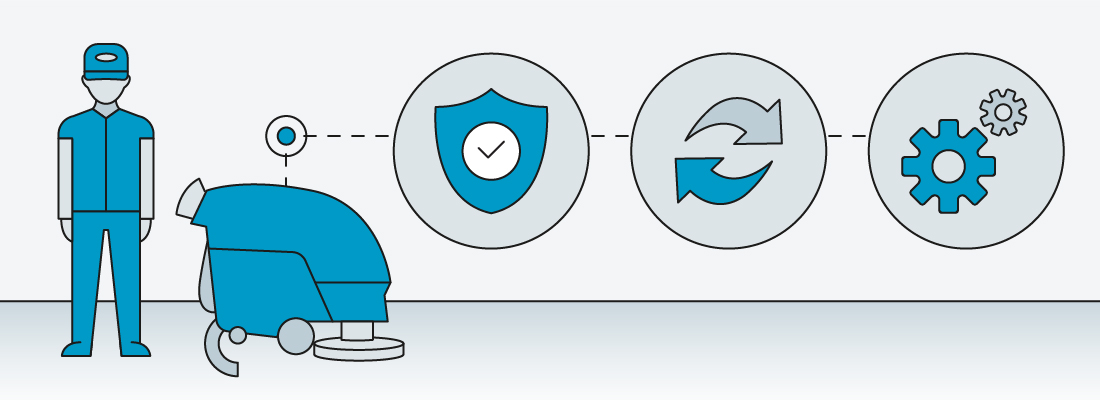
TennantTrue® service plans are structured around predictability—converting an unpredictable cost center into a fixed one. Plans range from flexible pay as you go maintenance to full breakdown coverage with guaranteed response times, bridging machines, repair parts, and operator training.
Long-term performance matters more than the initial invoice. The biggest cost differences show up over three to five years, shaped by run time, energy use, maintenance, and uptime.
Technology choices influence how effectively teams work. Equipment that supports consistent performance and reduces repetitive workload helps staff focus on higher-value tasks.
Sustainability is now part of everyday procurement. The ability to document environmental performance is increasingly influencing tender outcomes and contract renewals
Service models determine operational reliability. Predictable maintenance, fast response times, and access to parts and expertise help prevent avoidable disruption.
Interested in understanding what total cost of ownership looks like for your operation? Speak to a Tennant specialist here.
RELATED LINKS
5 Ways Robotic Floor Cleaners are Revolutionizing Retail & BSC Cleaning
Best Practices for Cleaning Warehouse and Logistics Environments
Evaluating Floor Cleaning Machines for your Business? Consider Reconditioned
Whether you are requesting a product demonstration or a quote, ordering parts, or making a service appointment, you've come to the right place. Tennant professional representatives are ready with answers to your questions, and we look forward to showing you how much we appreciate your business.