Your shopping cart is empty.
There was an error retrieving your cart. Please try again later.
Posted in Cleaning Solutions, Robotic Cleaning Machines, Productivity,
Labour shortages are forcing facilities teams to make trade-offs they do not want to make — in France alone, the European Labour Authority cites 80,000 cleaner vacancies, or 3 percent of national vacancies.[1]
From the Floor is a series drawing on the experiences of Tennant's sales and service specialists across Europe. The insights in this edition reflect what teams are seeing day to day across the UK, France, Germany, Spain, and Portugal — on site, after the sale, and over time.
This article focuses on the hidden value of floor cleaning robots — and why their impact extends beyond cleaning performance.
That value becomes most visible in real operations. An autonomous floor scrubber running a route is not the point. What matters is the consistency it brings — and what that consistency allows teams to do differently.
"Autonomous Cleaning allow other valued tasks to be completed — not always cleaning."
Jonathon Collett, Tennant MHE Industrial National Account Manager
In practice, the shift is not about replacing roles. It is about reshaping how time is used — with predictable coverage handled in the background, and people focused on the work that keeps sites safe, audit-ready, and running smoothly.
When teams are stretched, the impact shows up first in variability — which areas get cleaned, how thoroughly, and how often. It becomes harder to cover late shifts. Overtime grows. Supervisors end up managing gaps instead of managing standards.
David Herráez, Country Manager for Tennant Spain, has seen this first-hand: customers are “faced with the difficulty of covering night shifts, variability in cleaning quality, and high overtime costs.”
In practice, the value of autonomous cleaning comes from reducing variability and restoring predictability in daily operations.
Consistent coverage supports consistent standards. Repetitive floor cleaning becomes reliable, reducing the need for daily reallocation of tasks when teams are stretched.
People shift to higher-value work. When routine coverage is handled, staff can focus on detail cleaning, high-touch areas, and operational support across the site.
Teams feel supported — when implementation is done well. The human side matters. When autonomous cleaning robots are positioned as a support tool, they help reduce pressure on teams rather than replace them. As Herráez notes, this can lead to “greater staff motivation by not feeling replaced but supported.
Herráez describes the impact clearly: “the customer observed the freeing up of personnel for higher value-added tasks, consistent and standardized cleaning, and improved safety (less cross-traffic with operators).”
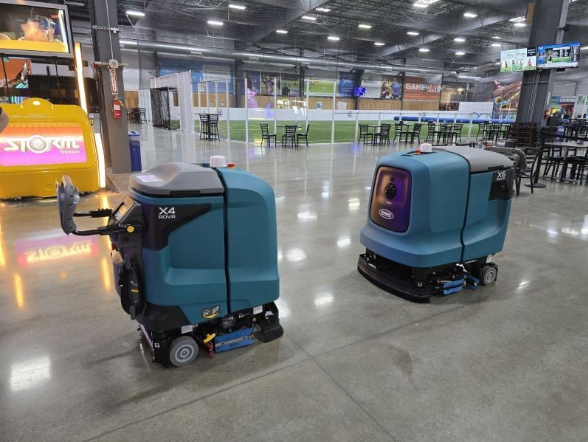
X4 ROVR and X6 ROVR Autonomous Floor Scrubbers
In a global organization operating over 1400 industrial and logistics facilities across 50 countries, Autonomous industrial cleaning robot were deployed in large warehousing and distribution environments to address labour constraints and reduce variability in day-to-day cleaning outcomes.
As Collett notes, it was “purchasing autonomous industrial cleaning robot to address labour shortages.”
Technology enables the shift — but the outcome is operational. When predictable coverage is handled, teams can reallocate time to the work that improves service quality and keeps a site running smoothly day to day.
A pattern we see across implementations is that customers start with one objective — reducing labour hours — and then discover broader benefits once autonomous floor scrubbers are embedded into daily operations.
Herráez explains it this way: “the customer initially sought only to reduce staff hours, but ended up also achieving improvements in safety, cost optimization, … as well as an improvement in image and service quality in front of customer visits and auditors.”
As autonomy matures, the biggest advances are increasingly happening in software — the capabilities that help autonomous floor scrubbers generate routes, adapt on the fly, and require less day-to-day intervention. BrainOS® Clean 2.0 is one example of that shift. Publicly shared results have shown up to 22 percent expanded coverage, 55 percent improved autonomy, and more than three times faster deployments versus traditional “teach and repeat” approaches.
Cleaning work doesn’t go away. But in a labour-constrained market, the mix of work can change in a way that helps teams protect standards — and focus their time where it delivers the most value.
If you’re exploring automatic floor cleaning machines because labour is tight, the best place to start is the workflow: what needs to be consistent every day, what needs a human touch, and what your team could do with more time back.
Talk to us about your cleaning workflow today.
Sources:[1] European Labour Authority (ELA), EURES Report on labour shortages and surpluses 2024 (PDF), reference to cleaner vacancies in France.RELATED LINKS
10,000 Robotic Floor Scrubbers
in the field
Five critical challenges impacting
industrial cleaning
AMR Myths: What’s Fact and
What’s Fiction?
Whether you are requesting a product demonstration or a quote, ordering parts, or making a service appointment, you've come to the right place. Tennant professional representatives are ready with answers to your questions, and we look forward to showing you how much we appreciate your business.