Your shopping cart is empty.
There was an error retrieving your cart. Please try again later.

How Optima combines robotics and human expertise to deliver consistently high-quality cleaning in complex airport environments
Cleaning activities in airports operate in one of the most demanding environments in the industry, with continuous activity 24 hours a day, seven days a week, and high passenger footfall. Ensuring high standards of cleanliness, safety and quality in this context requires solutions that deliver efficiency, reliability and constant adaptability to a dynamic environment.
To address this challenge, Optima, a leading integrated facilities management company, has implemented an operating model based on technological innovation and the combination of human resources and autonomous robotics at several key airports across Spain: Barcelona, Seville, Málaga, Alicante, Valencia, Menorca and Ibiza
Below, we take a detailed look at the case of Barcelona Airport, a particularly significant site due to its size, operational complexity and passenger volume, yet representative of the model Optima is deploying across other airports. Together with Albert Celaya, Service Manager for Optima Facility at Josep Tarradellas Barcelona–El Prat Airport, we explore how the integration of autonomous cleaning solutions has become a key driver for improving efficiency, service quality and sustainability in a 24/7 airport environment.
TECHNOLOGICAL INNOVATION FOR A 24/7 OPERATION
Cleaning services at Barcelona Airport take place in a highly demanding environment, characterised by continuous activity and heavy passenger traffic. Maintaining consistent levels of cleanliness under these conditions requires precise planning and the use of technological solutions that can integrate seamlessly into a dynamic setting.
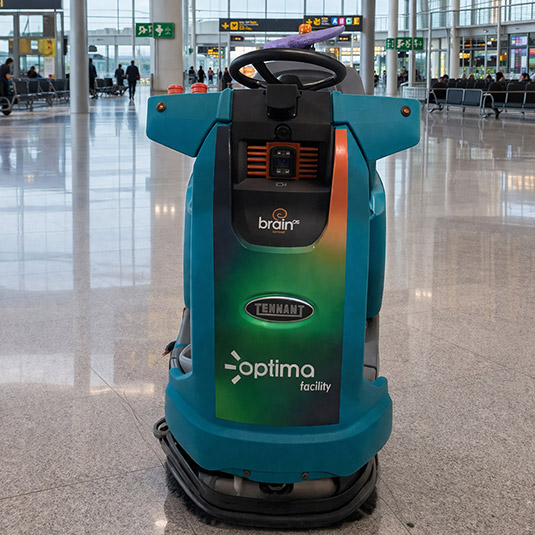
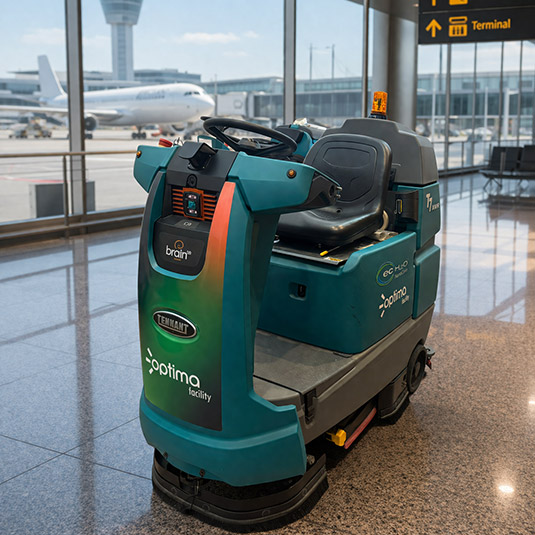
o meet these needs, Optima has implemented an operating model that combines conventional machinery with autonomous cleaning solutions. During the day, several robotic machines operate continuously in different areas of the airport, safely performing cleaning tasks even in zones with high pedestrian traffic. During the night shift, when passenger numbers are lower, conventional scrubbers and sweepers from manufacturer Tennant are used to reinforce and deepen the work carried out throughout the day.
The introduction of robotic scrubbers forms part of the company’s strategy of innovation and continuous improvement. The objective was to increase operational efficiency, ensure more consistent cleaning results and optimise the use of available resources.
“We were looking for a solution that would allow us to increase efficiency, guarantee uniformity in cleaning results and optimise the use of resources, while always maintaining the highest quality standards.”
— Albert Celaya, Service Manager, Optima Facility at Josep Tarradellas Barcelona–El Prat Airport
One of the decisive factors in selecting these solutions was the autonomy and artificial intelligence technology integrated into Tennant’s machines. This platform has been specifically designed for complex commercial environments and has extensive operational experience in real-world facilities worldwide, ensuring a high level of reliability, safety and adaptability to dynamic environments such as airports.
“At Optima, we particularly value the fact that these solutions improve productivity and service quality, while at the same time reinforcing our commitment to more sustainable and environmentally responsible management, aligned with the environmental objectives of AENA and the airport itself.”
Francisco Javier López Koskinen,
Regional Director Levante, Balearic Islands & Airport Division
GREATER OPERATIONAL EFFICIENCY AND ADDED VALUE FOR HUMAN TEAMS
The introduction of Autonomous Cleaning Robots has brought about a significant evolution in service organisation. Thanks to these solutions, some of the most repetitive tasks— such as scrubbing or sweeping large surface areas—can be automated, allowing human teams to focus on activities that require greater specialisation, attention to detail or supervision.
This approach has improved service productivity and optimised cleaning task planning. In addition, monitoring and data analysis tools provide real-time information on machine performance, supporting decision-making and continuous improvement of operations.
Automation has also helped optimise working time. This optimisation is not seen as a reduction in service, but as an enhancement of its quality, enabling more precise interventions tailored to the actual needs of each airport area.
From a resource management perspective, autonomous solutions act as a support for the existing team. For example, they reduce the need to hire additional staff for specific tasks, while ensuring operational continuity even on days with lower staff availability. A single operator can supervise several machines simultaneously, expanding service coverage without compromising the quality of the final outcome.
A HYBRID FLEET MODEL FOR A DYNAMIC ENVIRONMENT
Airport operations are based on a hybrid fleet model that combines conventional equipment with autonomous solutions. This approach provides great operational flexibility and allows the service to adapt quickly to different situations.
“Airport operations are based on a hybrid fleet model that provides us with great operational flexibility. In situations such as incidents or temporary reinforcements, conventional machines allow rapid intervention, while autonomous solutions expand service coverage and improve cleaning frequency in specific areas.”
— Albert Celaya, Service Manager, Optima Facility at Josep Tarradellas Barcelona–El Prat Airport
In practice, the same operator who performs conventional scrubbing in one area can activate and supervise an AMR in additional zones. This model multiplies team productivity and allows cleaning coverage across the airport to be extended.
Service management is also supported by traceability systems and data analysis. A detailed report of completed tasks is sent daily to AENA, while more comprehensive © 2026 Tennant Company monthly reports are produced to assess the efficiency and scope of operations carried out by the robots.
Data security is a critical criterion, on a par with the operational efficiency the machine can provide.”
— Albert Celaya, Service Manager, Optima Facility at Josep Tarradellas Barcelona–El Prat Airport
SUSTAINABILITY, INNOVATION AND THE PASSENGER EXPERIENCE
In addition to improving operational efficiency, robotic solutions contribute to the airport’s sustainability objectives. Thanks to their technology, they optimise the use of water, energy and cleaning products in each working cycle, reducing the environmental impact of operations..
The presence of robots within the facilities also has a positive impact on passenger perception of the service, as travellers often show curiosity when seeing them working autonomously.
As Albert Celaya explains:
“Passengers’ reactions are usually very positive. These are highly eye-catching machines that spark curiosity and surprise when seen operating autonomously in such a busy environment as an airport.”
THE FUTURE
Robotics is becoming firmly established as a strategic ally in improving efficiency, sustainability and the quality of cleaning services in large-scale airport infrastructure. Experience with Tennant’s autonomous machines has shown that technology can be integrated naturally, delivering efficiency, safety and sustainability.
Optima’s objective is to continue expanding its fleet in the coming years, not only in terms of quantity but also in capabilities, incorporating smarter and more connected solutions that enable even more efficient resource management.
In short, robotics will continue to be a key partner in reinforcing service quality and advancing Optima’s commitment to innovation and sustainability.;